


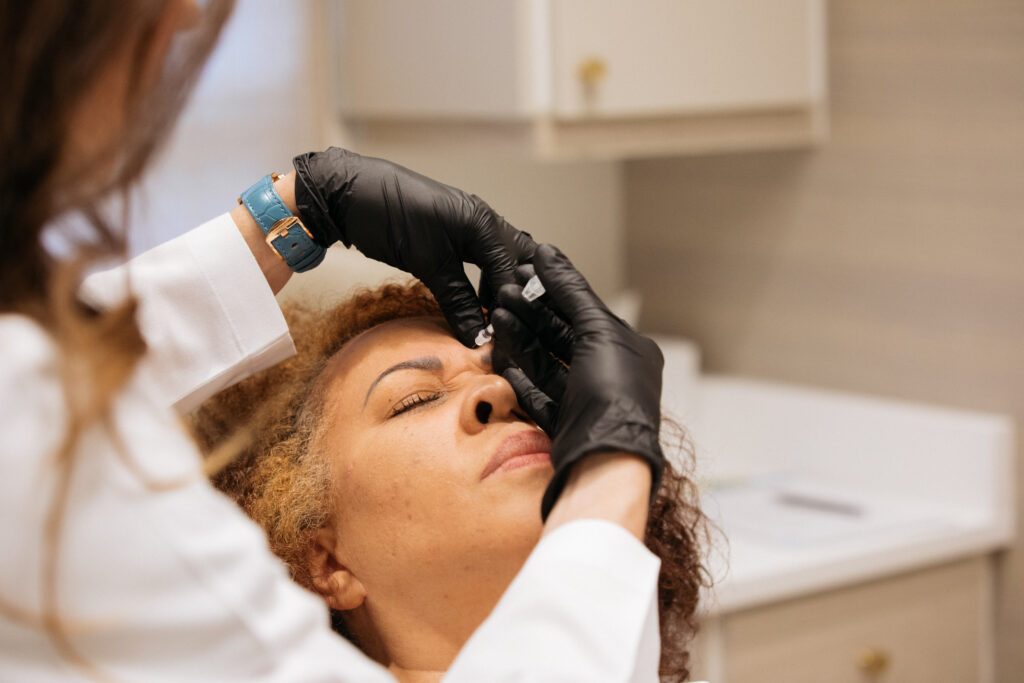
Looking younger is no longer a challenge thanks to today’s advanced cosmetic injectables, which can achieve smoother skin and refreshed facial contours without surgery. At Carolina Facial Plastics, patients exploring Botox in Charlotte have access to some of the most trusted injectable options available. Recognized as the #1 medspa and facial plastic surgeon in Charlotte by the BOB Awards, our practice delivers expert care that prioritizes natural-looking, confidence-boosting results.
Under the expertise of Jonathan Kulbersh, MD, and supported by a team of experienced injectors, facial rejuvenation is approached with precision, education, and a commitment to expert, high-quality treatments. Two of the most frequently requested cosmetic injectables are Botox and Dysport. While both are widely used to treat facial wrinkles, understanding the key differences between them helps patients make confident, informed decisions.
Facial rejuvenation often focuses on smoothing forehead lines, softening frown lines, minimizing crow’s feet, and improving overall facial expressions. Both Botox and Dysport use botulinum toxin to relax muscles that contribute to dynamic wrinkles. However, each offers unique advantages depending on the treatment area, muscle activity, and individual anatomy.
Today, we will explore these options in detail so you can clearly understand how they work, what concerns they treat, and how to make a confident, informed decision.
What is Botox Cosmetic?
Botox Cosmetic is one of the most recognized injectable treatments in aesthetic medicine. It is FDA-approved for the treatment of forehead lines, crow’s feet, and glabellar lines. Botox Cosmetic works by temporarily blocking nerve signals that cause muscle contractions, allowing the overlying skin to appear smoother and more refreshed.
Furthermore, Botox injections are precisely placed into targeted facial muscles. By limiting muscle activity, Botox helps soften facial lines that form from repetitive expressions, such as squinting, frowning, or raising the eyebrows. These botulinum toxin injections help treat facial wrinkles while preserving natural facial expressions when administered correctly.
Botox treatments typically produce visible improvement within several days. Botox typically reaches full effect within one week, with treatment effects lasting three to four months for most patients. Beyond aesthetic enhancements, Botox also has cosmetic and medical applications, including treatment for TMJ, excessive sweating, muscle spasms, overactive bladder, and urinary incontinence.
Understanding Dysport Injections – How Dysport Approaches Wrinkle Reduction
Dysport injections are also FDA-approved and are commonly used to treat moderate to severe glabellar lines. Like Botox, Dysport is a botulinum toxin type A injectable that works by blocking nerve signals responsible for muscle contractions.
One notable distinction is how Dysport spreads beneath the skin. Dysport spreads more readily, making it particularly effective for treating broader areas, such as the forehead or severe frown lines. For patients with thick skin or strong muscle activity, Dysport treatments may provide a more even result across the treated area.
Dysport injections often show results within two to three days, which may appeal to individuals seeking faster visible improvement. While early changes may be noticeable quickly, full results typically continue to develop and settle over the course of up to 14 days. Dysport results are similar to Botox results and generally last three to four months, depending on muscle strength and injection site placement.
FDA-Approved Treatments and Patient Safety
Both Botox and Dysport are FDA-approved treatments that meet strict safety and efficacy standards. FDA-approved status ensures that these injectable treatments have undergone extensive clinical testing and regulatory review.
Botox Cosmetic is approved to treat forehead lines, crow’s feet, and glabellar lines. Dysport is approved for severe glabellar lines and is widely used for treating wrinkles caused by repeated muscle contractions. Both options are also used in cosmetic and medical applications, reinforcing their versatility and long-standing clinical use.

Comparing Botox and Dysport – Key Differences That Matter
When comparing Botox and Dysport, the key differences relate to molecular structure, diffusion, dosage, and unit measurement. Understanding the difference between Botox and Dysport helps patients choose the most appropriate solution for their aesthetic goals.
Botox stays more localized, offering high precision for specific muscles and smaller treatment areas. Dysport spreads more evenly, which can be advantageous when treating broader areas such as the forehead or glabella lines. Dysport and Botox units are not interchangeable, and more Dysport units are often required to achieve similar results.
Dysport vs Botox is not about which option is better universally. Instead, the choice depends on facial anatomy, muscle strength, desired outcomes, and the treated area’s response to botulinum toxin type A.
Treatment Areas and Aesthetic Concerns
Both Dysport and Botox are commonly used to treat facial wrinkles in multiple regions of the face. These include forehead lines, vertical lines between the eyebrows, crow’s feet, and glabellar lines.
The selected treatment area influences whether Dysport or Botox is recommended. Botox is often preferred for highly specific muscles, while Dysport is frequently chosen for treating broader areas with stronger muscle activity. Treating wrinkles effectively requires careful evaluation of facial lines, muscle movement, and the overlying skin.
A personalized treatment plan ensures the best outcome. Factors such as facial expressions, muscle activity, thick skin, and medical history all influence product selection and dosing.
Procedure Experience and Recovery Time – What Patients Can Expect
Both Botox and Dysport procedures take only a few minutes to complete. In fact, most appointments last only a few minutes from start to finish. The injection site is carefully selected to ensure precise placement into specific facial muscles.
Recovery is minimal, and most patients return to normal activities immediately. Mild swelling or redness at the injection site may occur but typically resolves quickly. Proper aftercare supports optimal treatment effects and longevity.

Dysport vs Botox Cost – Considerations and Overall Value
The cost difference between Botox and Dysport depends on dosage, treatment area size, and individual needs. Dysport units are often priced lower than Botox units, although more Dysport units may be required for comparable correction.
Botox units and Dysport units are calculated differently, so comparing pricing alone does not reflect the overall value. Both options offer significant improvement in fine lines and wrinkles, contributing to a more youthful appearance.
Consulting experienced plastic surgeons or board-certified dermatologists ensures transparency and proper guidance when evaluating treatment costs.

Who is a Good Candidate for Botox or Dysport?
Adults between the ages of eighteen and sixty-five with dynamic wrinkles are often excellent candidates for these two treatments. Individuals with botulinum toxin sensitivity, certain neuromuscular conditions, or those who are pregnant may not be suitable candidates.
Before moving forward with treatment, a thorough medical history review is essential. During this process, factors such as muscle spasms, prior cosmetic injectable treatments, facial anatomy, and muscle contractions are carefully evaluated to ensure safe and effective results.
Botox Results and Long-Term Expectations
Botox results typically begin to appear within three to seven days and take up to 14 days to settle fully. Botox works by temporarily blocking nerve signals, helping prevent muscle contractions and softening facial wrinkles.
Most patients experience noticeable improvement in fine lines, frown lines, crow’s feet, and forehead lines. Botox results are temporary, which allows flexibility in adjusting future treatments as facial aging evolves.
Key Benefits at a Glance
- Treats dynamic wrinkles caused by muscle contractions
• Softens forehead lines, frown lines, and crow’s feet
• Improves facial expressions while preserving natural movement
• Requires only a few minutes per session
• Minimal recovery with immediate return to daily activities
Dysport and Botox: Choosing the Right Option
Dysport and Botox are both powerful tools for treating wrinkles, yet they serve slightly different purposes. Dysport and Botox comparisons often highlight diffusion patterns and onset speed. Dysport spreads more evenly, while Botox provides targeted precision.
Treating broader areas may favor Dysport, while highly specific muscles may respond better to Botox. Decisions about Dysport vs Botox are best made with expert guidance rather than assumptions.
Dysport and Botox in Charlotte – Your Path to Confident Facial Rejuvenation
Choosing between Dysport and Botox is a personal decision guided by anatomy, goals, and professional expertise. Understanding the key differences empowers patients to feel confident in their treatment choices.
At Carolina Facial Plastics, patients benefit from advanced cosmetic injectables guided by experience, education, and artistry. Under the leadership of Jonathan Kulbersh, MD, each personalized treatment plan is designed to enhance natural features and support long-term confidence.
Considering Dysport and Botox in Charlotte and wondering which option is right for you?
A professional consultation provides the clarity, guidance, and trusted expertise needed to move forward with confidence and achieve refined, natural-looking results.
Schedule your consultation today!
To learn more about the differences between Dysport and Botox, check out this study from the National Institute of Health.