Forehead wrinkles can be frustrating because they often say more than you intend. Fine forehead lines, deep lines, frown lines, and brow drooping can make your face look tired, tense, or older, even when you feel energized.
At Carolina Facial Plastics in Charlotte, NC, many patients want to know whether a Botox® brow lift or a surgical brow lift is the better option for creating a more refreshed appearance.
The answer depends on what is causing concern. A Botox brow lift can be an excellent option for patients who want a subtle lift, smoother expression lines, and minimal downtime.
On the other hand, a surgical brow lift may be the better choice when sagging skin, hooded eyelids, heavy eyelids, or deeper wrinkles need a more structural correction.
Both options can help create natural-looking results, but they work in very different ways. A Botox brow lift uses Botox injections to relax muscles that pull the brows downward. On the other hand, a surgical brow lift physically repositions tissue to elevate the brow line. Because of that, choosing between the two starts with understanding your facial muscles, skin laxity, and long-term goals.
Botox Brow Lift vs Surgical Brow Lift
A Botox brow lift is a nonsurgical cosmetic procedure that uses Botox injections to relax specific muscles around the forehead and brows. When those muscles relax, the elevator muscles can help lift the brows slightly, creating a refreshed and youthful look.
A surgical brow lift is a plastic surgery procedure that elevates the brow by repositioning deeper tissues and addressing sagging skin. This makes a surgical brow lift more appropriate for patients who need a dramatic lift or who have brow drooping that affects the upper eyelids.
In simple terms, a Botox brow lift is best for mild to moderate concerns caused by muscle movement. A surgical brow lift is best for more brow descent, heavy eyelids, poor or flat brow arch, or excess skin.
A Botox brow lift can help soften forehead wrinkles and frown lines, while a surgical brow lift can improve brow position and arch more significantly. However, the right option is not always one or the other. In some cases, Botox treatments can be used after surgical procedures to maintain smooth forehead lines and support a more youthful appearance over time.

How Botox Brow Lifts Work
A Botox brow lift works by targeting facial muscles that control brow position. Some muscles help lift your brows, while others pull them downward. When Botox relaxes the muscles that pull the brows down, the brows may lift naturally, creating a more open and refreshed appearance.
The frontalis muscles are the muscles of the forehead that raise the brows. Meanwhile, the corrugator muscles and other depressor muscles contribute to frown lines, glabellar lines, and downward pull around the brows. When these treated muscles are carefully injected, the result can be a balanced lift without making the face look stiff or overdone.
This is why an experienced injector is so important. A Botox brow lift requires a thoughtful understanding of muscle groups, injection sites, and the patient’s unique facial structure. Too much Botox in the wrong area can weaken the forehead muscles too much, which may lead to temporary drooping or heaviness. When done correctly, however, a Botox brow lift can create a natural-looking lift while helping smooth forehead lines. Botox can also be used to change a flatter brow contour to a more arched appearance.
A Botox brow lift is not designed to remove sagging skin. Instead, Botox works by reducing muscle movement. For patients whose forehead wrinkles are mainly caused by repeated expressions, a Botox brow lift can make a noticeable difference.
What a Botox Brow Lift Can Improve
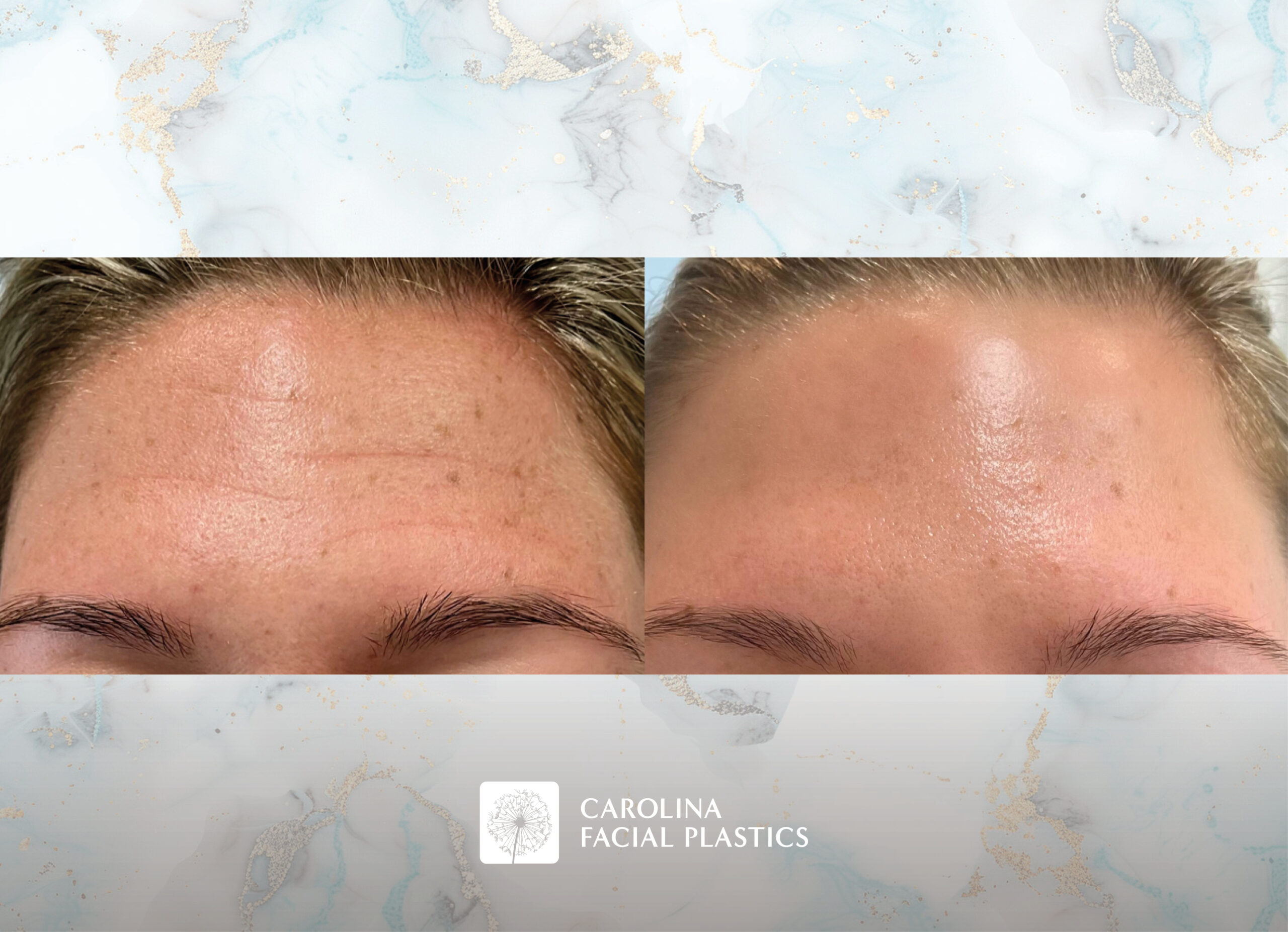
A Botox brow lift may improve mild brow drooping, forehead wrinkles, frown lines, and a tired expression. Because Botox relaxes the muscles responsible for certain expressions, it can help reduce the appearance of lines caused by repeated movement.
A Botox brow lift may help with:
- Mild brow drooping
- Forehead lines caused by muscle movement
- Severe frown lines in some patients
- Glabellar lines between the brows
- Mild heaviness near the upper eyelids
- A tense or tired look
- Uneven brow position
- The desire for a refreshed appearance without surgery
Additionally, a Botox brow lift can be appealing to patients who want a refreshed, youthful look without taking significant time away from their daily routine. Most patients can return to normal activities immediately, although minor bruising, redness, or tenderness can occur near the injection sites.
However, a Botox brow lift has limits. It cannot remove loose skin, reposition tissue, or create the same dramatic lift as a surgical brow lift. Therefore, patients with hooded eyelids, droopy eyelids, or heavy eyelids may need surgical intervention to achieve their desired result.
Can Botox Lift Sagging Brows?
Yes, Botox can lift sagging brows when the concern is mild and related to overactive muscles that pull the brows downward. A Botox brow lift works best when the brow drooping is caused by muscle movement rather than loose skin or significant tissue descent.
This is where the difference between a Botox lift and a surgical lift becomes important. A Botox lift can create a subtle lift by relaxing the depressor muscles. As a result, the elevator muscles can function more effectively, allowing the brows to lift naturally.
However, if sagging skin is the main issue, a Botox brow lift may not provide enough improvement. Patients with hooded eyelids, droopy eyelids, heavy eyelids, or deeper wrinkles often need a surgical brow lift because surgery can address the underlying tissue position.
In other words, a Botox brow lift can be a smart option for mild concerns, while a surgical brow lift is usually better for more advanced changes.
How a Surgical Brow Lift Works
A surgical brow lift is designed to elevate the brow line and improve heaviness around the upper face. Unlike a Botox brow lift, which temporarily relaxes muscles, a surgical brow lift creates a structural change by repositioning the brow and supporting tissues.
This can be especially helpful for patients who have sagging skin, hooded eyelids, droopy eyelids, poorly arched brows, or deep lines that remain even when the face is relaxed. A surgical brow lift may also help patients who constantly raise their forehead muscles to compensate for brow heaviness. Over time, that repeated muscle movement can deepen forehead wrinkles and create a tired appearance.
A surgical brow lift is a plastic surgery procedure, so it involves more planning, downtime, and recovery than Botox injections. Still, for the right patient, it can provide a more dramatic lift and longer-lasting improvement.
Because every patient has a unique facial structure, the best surgical approach depends on anatomy, skin quality, brow position, and aesthetic goals. A plastic surgeon can determine whether a surgical brow lift, another form of facial rejuvenation, or a combination of other treatments is the best fit.
When Surgery May Be the Better Choice
A surgical brow lift may be the better choice when the concern is caused by sagging skin, heavy brows, or deeper tissue descent. While a Botox brow lift can soften expression lines and create a subtle lift, it can not physically remove excess skin or reposition the brow in the same way surgery can.
A surgical brow lift may be more appropriate for patients with:
- Significant brow drooping
- Hooded eyelids caused by a low brow position
- Droopy eyelids or heavy eyelids
- Loss of brow arch
- Deep lines that are visible at rest
- Sagging skin across the forehead or brow area
- Limited improvement from previous Botox treatments
- A desire for a more dramatic lift
- Interest in longer-lasting facial rejuvenation
That said, surgery is not always the first step. Some patients may begin with a Botox brow lift to see how a subtle lift affects their appearance. Others may already know they want a more noticeable change and may benefit from discussing surgical procedures sooner.
Ultimately, the best choice depends on whether the concern is caused by muscle movement, tissue laxity, or both.

Botox Brow Lift Results and Downtime
A Botox brow lift is popular because it is quick, customizable, and involves minimal downtime. During treatment, Botox injections are placed into specific muscles that influence brow position. The exact injection sites depend on how the patient’s facial muscles move and where the brows need support.
Results do not appear immediately. Most patients begin to notice improvement within a few days, with full results usually visible around two weeks after treatment. A Botox brow lift typically lasts about three to four months, although this can vary based on metabolism, muscle strength, and how much Botox is used.
Patients often ask how many units are needed for a Botox brow lift. The answer depends on the individual. The amount of Botox used will vary based on facial anatomy, forehead muscles, brow position, frown lines, and whether the treatment is intended to smooth forehead lines as well.
Using too much Botox or placing it incorrectly can affect the balance between elevator muscles and depressor muscles. This is why a Botox brow lift should be performed by an experienced injector who understands how Botox works across the upper face.
Follow-up treatments and maintenance treatments can help preserve a refreshed and youthful look over time.
Botox Brow Lift vs Surgical Brow Lift Comparison
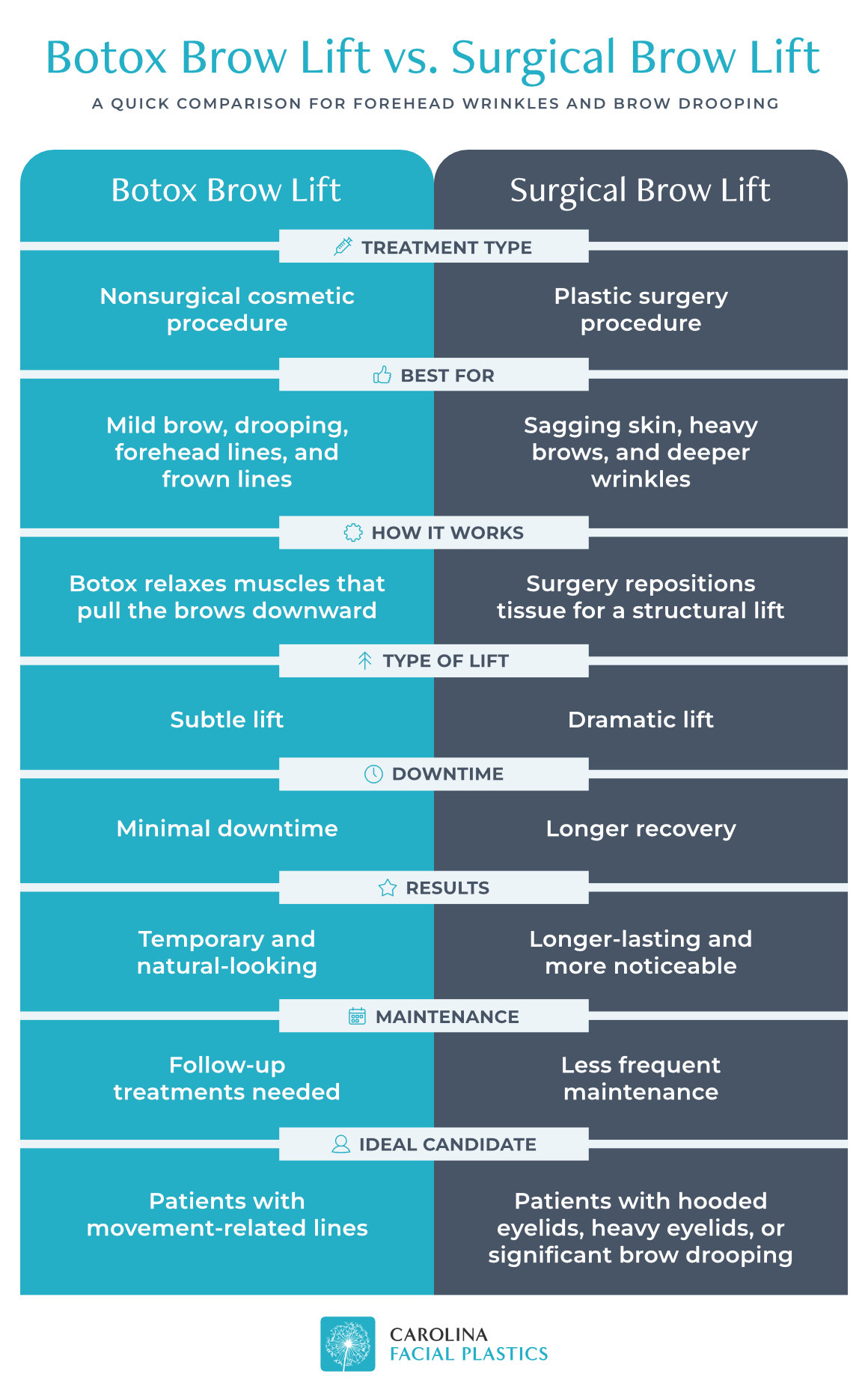
Both a Botox brow lift and a surgical brow lift can improve the upper face, but they serve different purposes. A Botox brow lift is often ideal for patients who want a natural-looking lift with minimal downtime. A surgical brow lift is more appropriate for patients who need a stronger correction for sagging skin or brow descent.
This comparison shows why the right choice depends on the cause of the concern. If forehead wrinkles are caused by active facial muscles, a Botox brow lift may be enough. If the issue is sagging skin or tissue descent, a surgical brow lift may yield better results.
Can Botox Help Hooded Eyes?
Botox may help with mild hooding when the heaviness is related to brow position and muscle activity. A Botox brow lift can create a more open look by relaxing the muscles that pull the brows downward.
However, Botox cannot remove excess eyelid skin. If hooded eyelids are caused by loose skin on the upper eyelids or significant brow drooping, a surgical brow lift, or another surgical intervention may be more effective.
This is also why patients should be evaluated carefully before choosing treatment. What appears to be an eyelid concern may actually be due to a low brow position. Likewise, what appears to be brow heaviness may sometimes involve the upper eyelids themselves. A thoughtful consultation can help identify whether a Botox brow lift, surgical brow lift, or another procedure is the right path.
Can Botox Make Eyebrows Too Raised or Too Low?
Yes, Botox can make the eyebrows look too raised or too low if the wrong muscle groups are affected. A Botox brow lift depends on balance. The goal is to relax muscles that pull the brows downward without over-weakening the forehead muscles that lift the brows.
If the frontalis muscles are weakened too much, the brows may feel heavy or appear lower. If certain depressor muscles are unevenly relaxed, the brow shape may appear overly arched. In many cases, these concerns are temporary and may improve as Botox wears off. Sometimes, careful follow-up treatments can help improve balance.
The best way to reduce this risk is to choose an experienced injector who understands how Botox works, where to place injection sites, and how to treat the upper face with precision.
Can Botox Be Combined with Other Treatments?
Yes, a Botox brow lift can be combined with other treatments to achieve more complete facial rejuvenation. For example, dermal fillers may help restore volume in areas that have changed over time, while laser treatments can improve skin tone, texture, and certain fine lines.
Additionally, patients who choose a surgical brow lift may still benefit from Botox treatments later. Surgery can lift the brows structurally, while Botox can help maintain smooth forehead lines and reduce frown lines caused by repeated muscle movement.
The timing matters. Dermal fillers, laser treatments, and Botox injections should be planned carefully so the skin and facial muscles respond predictably. When used thoughtfully, these options can enhance natural beauty and create a refreshed, youthful look without making the face appear overtreated.
Botox Brow Lift or Surgical Brow Lift: Finding Your Best Option
Choosing between a Botox brow lift and a surgical brow lift comes down to your anatomy, goals, and how much change you want to see. If you want a subtle lift, smoother forehead wrinkles, and minimal downtime, a Botox brow lift may be the right starting point. It can help smooth forehead lines, soften frown lines, and create a natural-looking lift without surgery.
However, if you have sagging skin, hooded eyelids, droopy eyelids, heavy eyelids, or deeper wrinkles that remain at rest, a surgical brow lift may be a better option. Because a surgical brow lift addresses tissue position, it can create a more dramatic lift and longer-lasting improvement.
Carolina Facial Plastics is proud to be voted Charlotte’s #1 MedSpa and facial plastic surgery practice in the BOB Awards, reflecting the trust patients place in the team for expert aesthetic care.
Whether you are considering a Botox brow lift, a surgical brow lift, or a combination of options, a personalized consultation can help you understand what will create the most natural-looking results.
A refreshed and youthful look should still feel like you. With the right approach, you can soften forehead wrinkles, improve brow drooping, and enjoy a more youthful appearance with results that look balanced, elegant, and natural.